

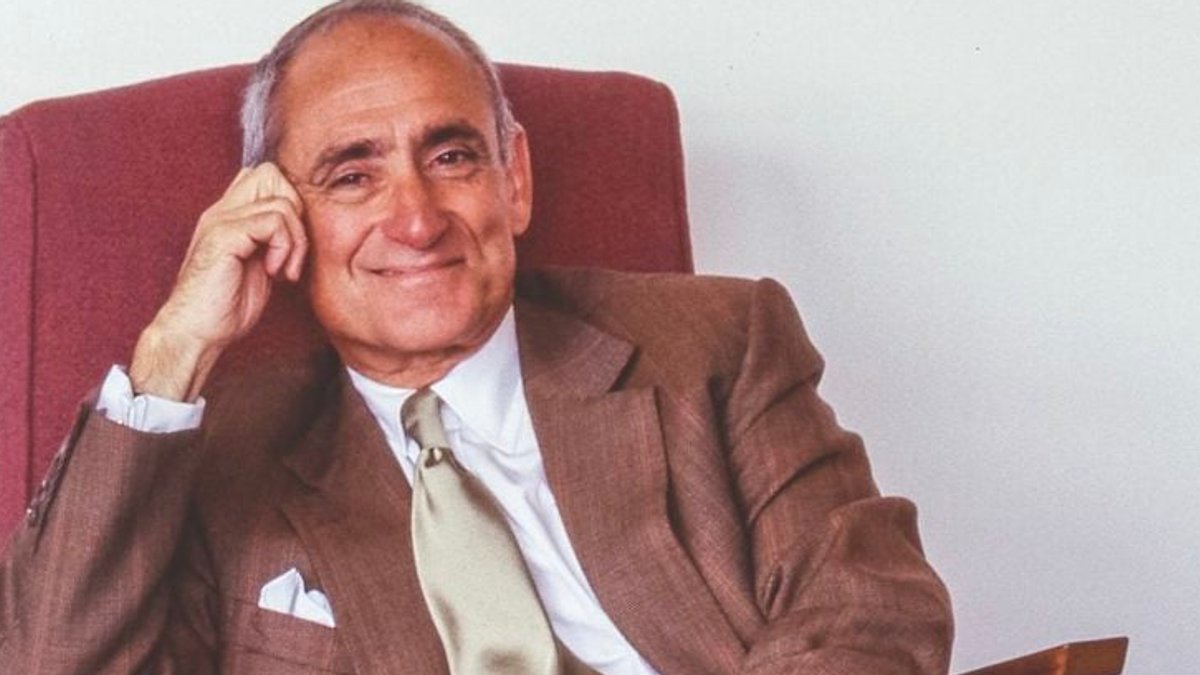
Robert A.M. Stern, who died in November at 86, reshaped contemporary architecture by treating history as a living language rather than a museum piece. His buildings, books, and classrooms demonstrated that architects could borrow from the past without apology—an idea that once set him apart but later gained widespread acceptance.
Born in Brooklyn, Stern studied at Columbia and Yale, where he learned from mentors like Paul Rudolph and Vincent Scully. As a student, he edited Perspecta 9/10, a landmark issue that paired Robert Venturi’s Complexity and Contradiction in Architecture with Charles Moore’s “You Have to Pay for the Public Life.” The double issue became a defining text for a generation challenging Modernism’s rigid rules.
From Postmodernism to a New Classicism
Stern’s early work in the 1960s and ’70s leaned into Postmodernism, though with a distinct approach. His weekend houses in Montauk and Connecticut combined Modernist forms with historical references—shingled boxes featuring arched cutouts or boldly painted facades that suggested Baroque influences.
By the 1980s, RAMSA shifted toward more disciplined interpretations of tradition. Projects like the Lawson House on Long Island and the Cohn House on Martha’s Vineyard moved beyond simple imitation, exploring the expressive potential of the Shingle Style.
The firm’s expansion brought larger projects: the Norman Rockwell Museum in Massachusetts, the H.H. Richardson–inspired Ohrstrom Library at St. Paul’s School, and a series of classical courthouses and libraries across the South.
Stern’s work at the University of Virginia illustrated this progression. The 1984 renovation of the Observatory Hill Dining Hall incorporated Doric columns modeled after Vignola, referencing Thomas Jefferson’s original campus design. Though controversial and later demolished, the project showed Stern’s belief that history could shape contemporary design without direct copying. Eight years later, RAMSA’s Darden School of Business adopted a more scholarly approach, dividing the program into pavilions connected by arcades, a strategy drawn from Jefferson’s Central Grounds.
Related: Artisans Preserve Americas Building Heritage
The George W. Bush Presidential Center at Southern Methodist University (2013) simplified Georgian architecture to its core elements, balancing the university’s traditional campus with the Bush Foundation’s modern goals. At Harvard Business School, the Spangler Campus Center (2001) extended the Georgian identity established by McKim, Mead & White in the 1920s.
Stern’s influence extended beyond traditional styles. RAMSA’s Comcast Center in Philadelphia (2008), a glass-clad obelisk, reimagined classical forms for a corporate skyscraper. His residential towers in New York, inspired by prewar masonry apartment buildings, adapted their proportions and materials for modern living. A Sotheby’s broker described this approach as “the Robert Stern school of architecture: limestone façades, classic finishes, timeless.”
Planning and Pedagogy
Stern’s impact reached beyond individual buildings. He played a key role in New Urbanism, though he preferred the term “traditional town planning.” His 1976 Venice Biennale project, “Subway Suburb,” and later book The Anglo-American Suburb (1982) argued that suburbia could address urban problems rather than simply reflect them.
This philosophy shaped large-scale projects like Celebration, Florida, Disney’s planned community, and RAMSA’s master plans for new towns in China. His revitalization of New York’s 42nd Street theater district in the 1990s showed how mixed-use urbanism could revive historic neighborhoods. Peter Pennoyer, a former employee, recalled Stern’s view that “the academy had developed an inappropriate antagonism toward suburbia and American middle-class values.”
As dean of Yale’s School of Architecture from 1998 to 2016, Stern brought together architects from diverse backgrounds—Leon Krier, Zaha Hadid, and others—as visiting professors. This inclusive approach helped return traditional architecture to academic discussions. Leopoldo Villardi, who worked on Stern’s memoir Between Memory and Invention (2022), suggested Stern might be remembered more for his teaching than his buildings. Mark Ferguson, who consulted Stern before becoming dean at Catholic University, said Stern advised him to “be present, visible, and accessible,” and to serve at least two terms—a lesson drawn from his own leadership.
RAMSA became a model for balancing design and management. Partners like Brian Sawyer and John Berson, who founded their own practice in 1999, adopted Stern’s emphasis on clarity and teamwork. “Bob taught us how to work,” Sawyer said. The firm’s structure allowed it to grow while maintaining a focus on craft, a rare achievement in large practices.
Related: Vacant or Underused Land in Maine
History as a Tool, Not a Relic
Stern’s scholarship informed his practice. His six-volume New York series documented the city’s architecture from the Civil War to the present, while Paradise Planned (2013), co-written with David Fishman and Jacob Tilove, examined the garden suburb’s role in modern urbanism. These projects weren’t just academic—they shaped the firm’s work, from residential towers to university campuses.
His personal library, containing more than 10,000 volumes, served as a resource for the office. Stern often commissioned books he wished existed, writing forewords for monographs on overlooked architects like Grosvenor Atterbury and Mott B. Schmidt. Samuel G. White, author of several books on McKim, Mead & White, noted that Stern “caused many of them to be written.”
Preservation was another focus. Stern directed Columbia’s preservation program in the 1990s and advocated for landmarking both historic and Modernist buildings. Roberta Brandes Gratz, president of the New York Landmarks Conservancy, called him “a great friend” who supported preservation efforts through letters, op-eds, and testimony. His work ensured history was protected, not just studied.
In his final years, Stern reflected on his legacy. His son, Nicholas, said he was “at peace” with his achievements. By then, Stern had met all three of his life goals: becoming dean of Yale’s architecture school, designing a building New Yorkers would remember, and creating an “author’s department” within his firm. The last goal ensured RAMSA’s work would be documented for future generations—a fitting conclusion for an architect who saw the past as always present.
Patrick Pinnell, who worked on RAMSA’s Gothic residential colleges at Yale, observed that Stern “had his eye on Eero Saarinen—in his belief in finding the style appropriate to the job.” That adaptability, combined with deep historical knowledge, allowed him to work across styles and scales. His buildings didn’t just reference history; they made it feel immediate and necessary.
His approach to traditional design influenced generations of architects, blending historical awareness with contemporary needs.


